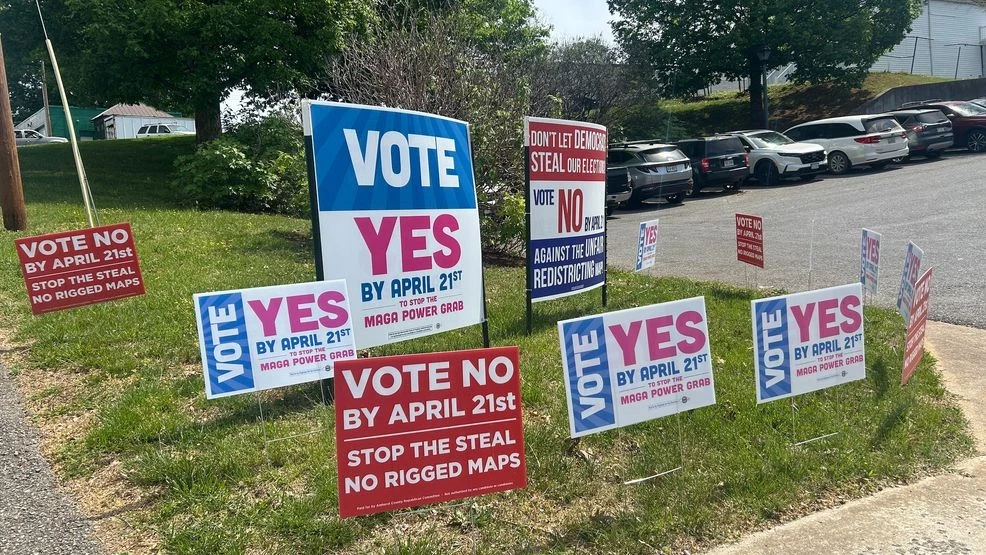
When Virginia Democrats pushed redrawing our congressional map mid-decade so they could pick up additional House seats, I joined many of my fellow conservatives in opposing it. The argument was straightforward: districts are supposed to be drawn once a decade, on the back of the census, by a process that (although imperfect) respects the premise that voters choose their representatives, not the other way around. Tearing up the map between cycles to cement a partisan advantage was, we said, a corruption of that premise.
I still believe that.
So, it’s pained me to watch as that same principle has been bulldozed in Republican states, with the cheerful approval of many of the same people who opposed it here.
The story playing out in the Indiana primary this week captures the hypocrisy cleanly: a handful of Republican state senators resisted the political pressure to redraw Indiana’s congressional lines. And this week, they lost their primaries to challengers powered by the President’s opposition to their stand. They didn’t switch sides; they just said that what was wrong when the other party did it is still wrong when their party tries it. For that, they paid with their careers.
But why is this a principle we should hold?
Let’s start with what a district is supposed to be. Theoretically, you take a community of people who share geography, interests, and a common civic life, and you draw a line around them so that one person in Washington can speak on their behalf. The community is the input; the district is the output.
Gerrymandering reverses that. Mapmakers sort voters by partisan profile, slice neighborhoods in half, splice unrelated areas together, and draw districts where the only organizing principle is the desired vote share. Now the desired result is the input; the district is the output.
That isn’t representation. It’s the legislature reaching down into the electorate to manufacture election results.
That inversion has practical consequences that go well beyond which party wins a given seat. The most important is that mapmakers, not voters, become the real political actors in the country. A rigged district turns every voter into a unit to be sorted into a column rather than a citizen to be persuaded. The work of building a movement, making a case, and winning an argument gets replaced by the work of drawing a line in the “right” spot. If you actually believe that ideas should win on the merits, that ought to bother you.
This also breaks accountability, which is the whole point of having elections in the first place. The deal a republic strikes with its citizens is simple: if your representatives perform badly, you can throw them out. Gerrymandered maps quietly nullify that deal. They lock in outcomes for a decade regardless of how the incumbent governs. They tell voters that their judgment will be respected only insofar as it doesn’t disturb a pre-arranged result. That’s a corrosive message for any free society to send, and it doesn’t become less corrosive because the people sending it happen to share your jersey.
Midcycle redistricting takes every one of these problems and pours gasoline on them.
A decennial map is tied to the census, an actual count of the people whose communities the lines are meant to track. It allows districts to change as the population in our nation shifts.
A midcycle map isn’t tethered to anything but a vote count. It is, by definition, a redrawing whose only justification is “we didn’t like the last result.” That is the most naked version of the inversion I described: legislators looking at the choices their constituents made and deciding to redraw the constituents until the choices change. Done once, it is a serious abuse. Normalized, it becomes a loop in which the party in power simply re-tunes the electorate as needed, indefinitely, and the consent of the governed becomes an afterthought.
We are already watching the loop spin up. Each side cites the other’s conduct as a license for its own. Each side insists this time it’s necessary, this time it’s defensive, this time the rules don’t apply because of what *they* did first.
And every round of escalation makes the road back longer. Norms, once shattered, do not reassemble themselves. They have to be chosen, deliberately, by people willing to absorb a short-term loss for a long-term good.
That is what makes this a principle, and not a preference.
A principle is a commitment that binds you when it’s inconvenient. A line you draw only when you’re losing isn’t a line at all — it’s a tactic dressed up in moral language.
I would like to see conservatives say plainly that midcycle redistricting is wrong, full stop. Gerrymandering is wrong – even when it benefits your side. The fights worth winning are the ones that don’t require us to become what we said we opposed.
Is a principle still a principle when it costs you something? If the answer is no, then it was never a principle. It was a talking point. And we should stop pretending otherwise.